Eve and the Serpent
This is one of the Bible stories about temptation. For a later story about a hunger that trades away the future, see Esau and the birthright. For verses on Wisdom and Trust, see those topic pages. Text: World English Bible (public domain).
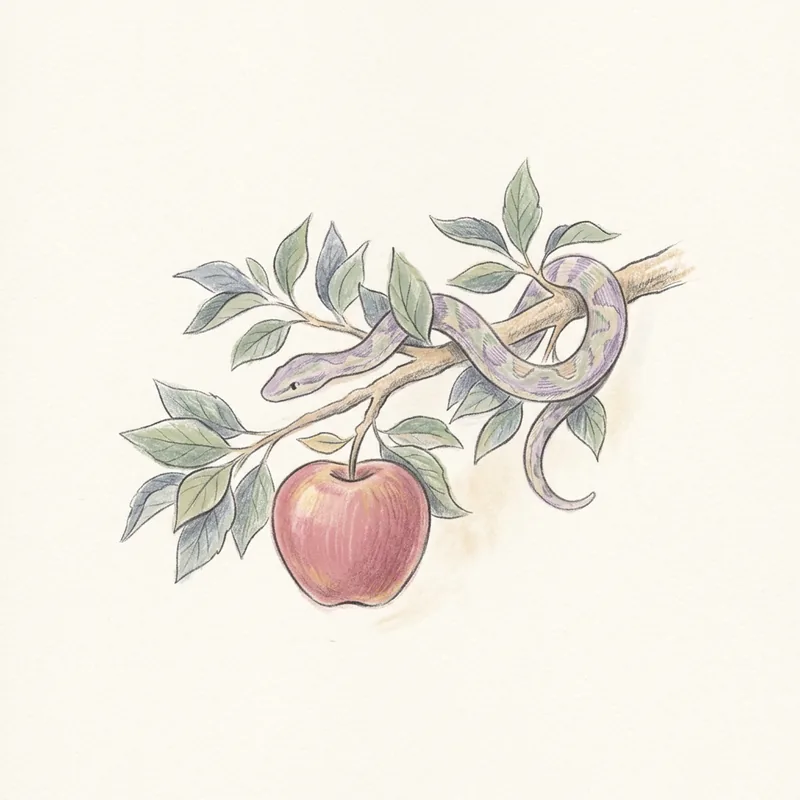
In Genesis 3, a serpent asks Eve whether God has really forbidden the fruit, she and Adam eat it, and they are sent out of the garden. The story is often read as the first temptation in the Bible, and it still resembles the modern habit of asking “Is that really true?”
The story
In the beginning of the human story, God placed the first man and woman in a garden. He gave them every tree for food, with one boundary: they were not to eat from the tree of the knowledge of good and evil. “In the day that you eat of it,” God said, “you will surely die.”
A serpent, described as more subtle than any animal of the field, came to the woman with a question that slightly changed the command. “Has God really said, ‘You shall not eat of any tree of the garden’?” God had not forbidden every tree — only one. The woman answered that they could eat from the trees of the garden, but not from the tree in the middle. She added a detail the original command had not named: they were not to touch it, or they would die.
The serpent contradicted God outright. “You won’t really die,” it said. Instead, it claimed, her eyes would be opened, and she would be like God, knowing good and evil. The woman looked at the tree again. It was good for food. It was a delight to the eyes. It was desirable for the wisdom it seemed to offer. She took some of the fruit and ate. She also gave some to her husband, who was with her, and he ate it too.
Their eyes were opened, but not in the way the serpent had advertised. They knew that they were naked. They sewed fig leaves together for coverings and hid among the trees when they heard God walking in the garden in the cool of the day. God called to the man, “Where are you?” The man said he was afraid because he was naked. When God asked whether he had eaten from the forbidden tree, the man pointed to the woman. The woman pointed to the serpent: “The serpent deceived me, and I ate.”
God sent them out of the garden. At the east, cherubim and a flaming sword guarded the way to the tree of life. The first temptation in the Bible begins not with a shout, but with a question that makes a clear word sound uncertain.
Key verses
Genesis 3:1. Now the serpent was more subtle than any animal of the field which Yahweh God had made. He said to the woman, “Has God really said, ‘You shall not eat of any tree of the garden’?”
Genesis 3:4–5. 4 The serpent said to the woman, “You won’t really die, 5 for God knows that in the day you eat it, your eyes will be opened, and you will be like God, knowing good and evil.”
Genesis 3:6. When the woman saw that the tree was good for food, and that it was a delight to the eyes, and that the tree was to be desired to make one wise, she took some of its fruit, and ate. Then she gave some to her husband with her, and he ate it, too.
Today
The serpent’s first move is still a familiar one: “Has God really said…?” — or, in ordinary life, “Is that really true?” A rumor, a headline, a private message, or a slightly twisted version of a rule can make a boundary look harsh or a source look untrustworthy.
The pattern in Genesis 3 is not only about fruit. It is about a claim that is almost right, a cost that is waved away (“You won’t really die”), and a promise of insider knowledge. Online, that can look like misinformation that spreads because it is easier to believe than to check, or like a voice that asks us to doubt a commitment we already understood.
The story does not pretend the woman and the man were helpless. They looked, they wanted, and they reached. Checking what was actually said — and what it would cost to ignore it — is the work the garden conversation skipped.